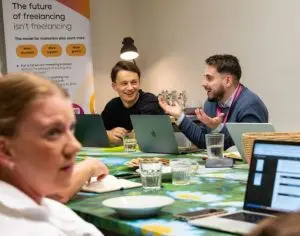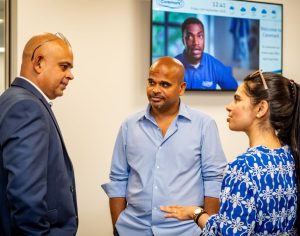
Earlier this year, I attended the International Franchise Association Convention 2026 in Las Vegas. It was a valuable few days and one that gave me time to reflect on leadership, growth and what franchise owners really need from the people leading a network.
Several keynote speakers stood out, particularly Kat Cole, Codie Sanchez and Andrew T. Cathy. They each came at leadership from a different angle, but there was a clear thread running through what they said. Good leadership is not about control for the sake of it. It is about responsibility. It is about making decisions that last, building trust across a network and recognising that long term success is rarely driven by short term thinking.
One story in particular has stayed with me because it so clearly illustrates a challenge that exists in every franchise system, regardless of industry. During her time leading Cinnabon, Kat Cole introduced the idea of smaller cinnamon rolls – what would later become the MiniBon. The response from franchise owners was immediate and forceful: “If you make us sell small cinnamon rolls, we will sue you. They did not see a simple product extension. They saw risk.
Many operators were already under significant pressure due to the economic climate at the time. They were worried that customers would trade down from higher margin products, further eroding already fragile profitability. In legal terms, the franchisor may well have had the right to push the change through. But in practical terms, that would not have solved the real issue.
That is the part I think many leaders can learn from.
Too often, resistance is met with authority. The franchise agreement is referenced, compliance clauses would be enforced, and the change would be pushed through regardless. You can mandate behaviour, but you cannot mandate belief, and without belief, execution is rarely effective.
What Kat Cole recognised was that the pushback was not really about the product itself. It was about fear, uncertainty and the feeling that the downside would sit with franchise owners. So instead of forcing the point, she spent time understanding the concern properly. She identified a small group of franchisees who were willing to test the concept in a controlled way, creating what she described as a “coalition of the willing.” More importantly, she personally guaranteed to make those early adopters whole if their sales declined.
In doing so, she removed the perceived downside risk and replaced it with a sense of shared commitment. The idea was no longer something being imposed; it became something being explored together.
The outcome is well documented. The MiniBon went on to drive a significant proportion of the brand’s growth and a substantial share of its profit improvement. But the more important takeaway is not the product itself; it is the process that made its success possible. The breakthrough did not come from the idea alone, but from taking the time to understand the “why” behind the “no” and responding to it with empathy and practical support.
That lesson feels particularly relevant as I reflect on our work at Caremark and across the domiciliary care sector more broadly. In care, the stakes are fundamentally higher than in most other areas of franchising. We are not simply introducing new products or refining commercial strategies. We are supporting vulnerable individuals, working within complex regulatory frameworks and carrying a level of responsibility that extends far beyond business performance.
Because of this, change must be approached differently.
The pace of innovation is important, but it can never come at the expense of confidence on the ground. Franchise owners and their teams need to feel not only capable of delivering change, but comfortable with it. They need to understand how it will affect their people, their customers and the quality of care they provide. Without that clarity, even well-intentioned initiatives can create hesitation or resistance.
That is why, in my experience, resistance is not usually a sign that people do not want to improve. More often, it is a sign that they are thinking seriously about what a change means. Franchise owners may be asking whether it will place more pressure on recruitment. They may be wondering how it fits with regulation, or whether it introduces pressures that could affect service quality. Those are not awkward questions. They are valid concerns, and they deserve to be acknowledged rather than overridden.
At Caremark, we have always believed that sustainable growth is built through alignment rather than enforcement. It is not enough to have the right strategy; it must be implemented in a way that brings people with us. That means creating space for dialogue, listening carefully to feedback and, where necessary, adapting our approach to ensure that change is both achievable and effective. It also means recognising that support is not a one-off intervention, but an ongoing commitment.
As networks grow, leadership must evolve with them. It is no longer just about setting direction; it is about enabling others to succeed within a shared framework. That requires consistency, transparency and a deep understanding of the realities faced by franchise owners operating in different local contexts. It also requires trust – not just in the system, but in the people who are part of it.
Trust is, ultimately, the foundation of everything we do in domiciliary care. It matters between franchisor and franchise owner. It matters between franchise owner and their team. Most importantly, it matters between care assistants and the people they support. Every decision we make has an impact on that trust, whether directly or indirectly. That is why the way we grow matters just as much as the growth itself.
Leaving Las Vegas, that is the perspective I am bringing back with me. Not a desire to accelerate for the sake of it, but a renewed focus on ensuring that every step forward is grounded in trust, alignment and purpose. Because in care, success is not measured solely by scale. It is measured by the quality, consistency and integrity of the service we provide, and by the confidence that people place in us every single day.