Data can feel intimidating. Customer records, sales figures, territory performance, demographics, competitors and market reports can quickly become an enormous mass of information. The more you collect, the harder it can be to know where to begin.
Of the top 10 brands in the 2026 EF100, 70% have worked with Atlas Mapping and subscribe to Vision. The same is true of 51% of brands named as BFA award finalists this year. These brands use data to understand their networks, support their decisions and plan what comes next.
The challenge is rarely the data itself. It is trying to tackle everything at once, or putting off the task altogether.
Start with the decision
One way to become overwhelmed is to start by asking, “What data do we have?” That can lead to opening several spreadsheets, finding inconsistent records and spending hours examining figures without a clear purpose.
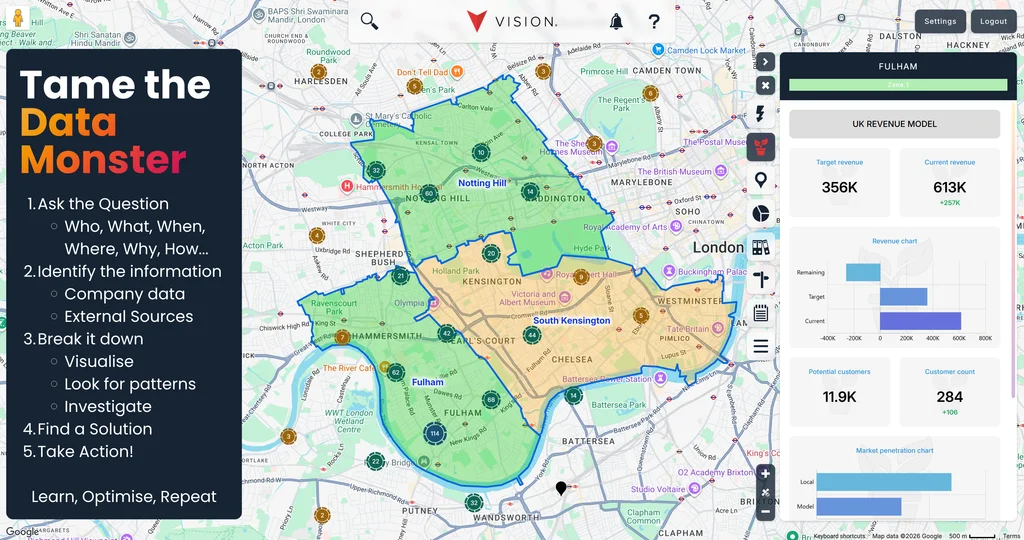
Start instead with the decision you need to make. You might want to identify where to recruit your next franchisee, understand why one territory is outperforming another, decide where to invest your marketing budget or establish whether your network still reflects the available opportunity.
Once the decision is clear, work backwards. What would you need to know to make it confidently? Which information is relevant, and what is missing?
Break the data monster into pieces
You do not need to understand your entire network in a single analysis. One area of focus is enough to get started.
Customer data can show where customers travel from, what they buy and how much they spend. Demographic data can help identify places where more customers with similar characteristics live. Competitor information can reveal whether strong locations benefit from limited competition or thrive within established commercial clusters.
Location data can show the effects of roads, drive times, transport links and natural barriers. Performance data can highlight which franchisees are capturing a strong share of their available market and which may need more support.
No single source tells the whole story. Together, they can help explain why something is happening. The territory generating the most revenue is not automatically the network’s best performer; it may simply have the largest market. Equally, a franchisee with lower revenue may be capturing an impressive share of a much smaller opportunity.
Breaking the problem into smaller parts makes those distinctions easier to see.
There is no such thing as perfect data
Many businesses delay analysis because their information is incomplete, inconsistent or spread across several systems. Perfect data would be ideal, but it is rarely the reality.
Some customer addresses may be missing. Franchisees may record sales differently, and historic records may not use the categories you would choose today. That does not make the information useless, particularly when tools can help you find what you need to get started.
The key is to understand its limitations. A smaller, representative sample can reveal meaningful patterns. An incomplete customer list can provide an initial indication of travel behaviour. Historic sales can help identify promising characteristics for future locations.
Start with what you have, identify the gaps and improve the information you collect from that point onwards.
Make it useful
Data creates value when it influences what happens next. It might show that your ideal customer differs from the audience described in your original franchise plan. It could reveal an overlooked region with strong potential or suggest that future territories should be planned differently.
It can help franchisors decide where to recruit, support franchisees with locally relevant marketing and identify territories performing below their potential. It can also guide decisions about products, pricing, opening hours and service delivery, while providing stronger evidence for prospective franchisees, lenders and investors.
Sometimes the findings challenge an assumption that has shaped the business for years. That can be uncomfortable, but discovering it before committing further investment is less frightening than discovering it afterwards.
A colourful dashboard or detailed report might look impressive. Its value lies in the action it inspires. The most important question is: “What will we do differently because we know this?”
The real risk is burying your head
Franchisors do not need to become data scientists. They need to get better at asking questions.
Begin with one commercial decision. Identify the information that could support it, break the problem into manageable parts, acknowledge the limitations and turn the findings into action.
The scariest position is not discovering something unexpected in your data. It is awarding territories, spending marketing budgets and planning future growth without examining the evidence.
Do not be afraid of what your data might tell you. Be more afraid of what you could miss by never looking.
This article comes courtesy of Atlas Mapping, the award-winning company behind Vision mapping software, which helps franchisors visualise and use data to map, optimise and grow their networks.