At first glance, franchising can look like the perfect shortcut to entrepreneurship. A recognised brand. A proven model. Built-in support. Financial freedom.
But according to the speakers at Elite Franchise Live, the reality is far less glamorous and far more demanding.
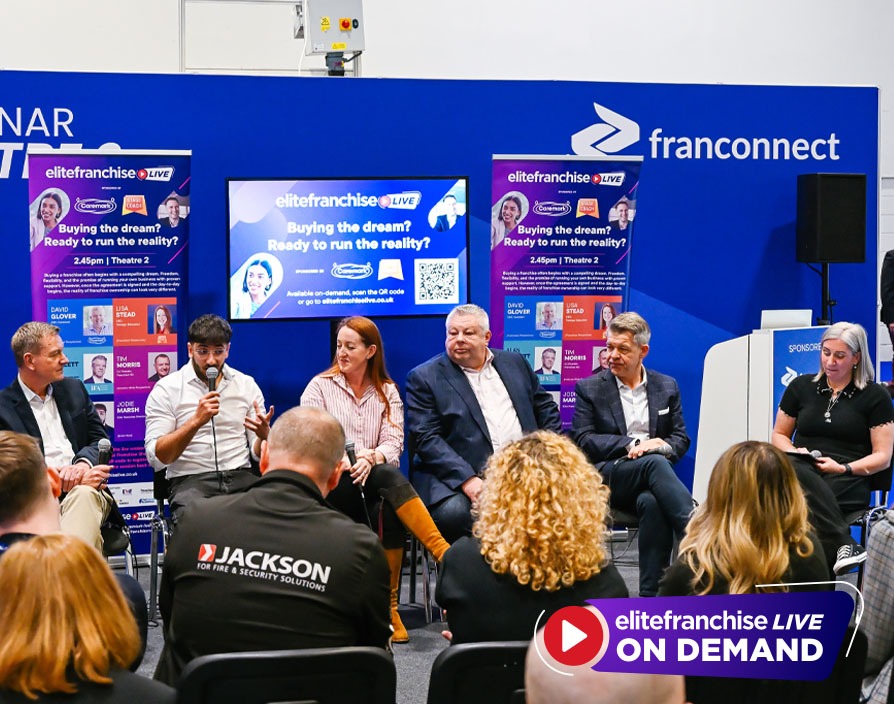
Hosted by Jodie Marsh at the International Franchise Show, the Elite Business panel brought together some of the most experienced voices in franchising for an unfiltered conversation about what happens after the franchise agreement is signed.
Featuring leaders from Caremark, Stagecoach Performing Arts, The International Franchise Association, Franchise HQ and franchisee Salman Niazi of Chicken Cottage, the session stripped away the polished sales messaging often associated with franchising and focused instead on the realities of resilience, leadership, local marketing and mindset.
The verdict? Franchising can absolutely work, but only for the right people.
“The hard work starts when you sign”
One of the strongest themes throughout the discussion was the misconception that buying a franchise means buying an easier route into business ownership.
David Glover, CEO of Caremark, was direct about the reality that many franchisees fail to anticipate. “The hard work actually starts the moment you sign the franchise agreement.”
For many prospective franchisees, the due diligence stage can feel like the biggest hurdle. But panellists repeatedly stressed that signing the agreement is not the finish line; it is the beginning.
Lisa Stead, CEO of Trafalgar Education and representative of Stagecoach, outlined three non-negotiables prospective franchisees need before committing:
- Sufficient funding
- Enough time
- Genuine passion for the business
“If you haven’t got the money and you haven’t got the time, they should be things that you do consider for not buying a franchise,” she explained.
It was a refreshingly honest perspective in an industry often marketed around flexibility and lifestyle freedom.
Instead, the panel painted a more realistic picture: long days, community networking, operational challenges and relentless consistency.
Alan Catlett, SVP Programmes and Operations at the IFA, summarised it simply:
“It’s your business. It’s only going to be successful if you’re doing it every day and thinking about it every day.”
Why local marketing still wins
Despite the rise of national branding, AI tools and sophisticated digital marketing systems, the panel agreed that franchise success is still built locally.
Repeatedly, speakers returned to one critical point: the franchisor cannot build your business for you.
For Glover, one of the biggest early mistakes franchisees make is waiting for customers to arrive simply because the brand exists.
“You need to get out there, you need to get involved in your community.”
Stead echoed the point, explaining that even globally recognised brands rely heavily on local franchisees creating visibility in their own areas.
“You’ve got to get out there on socials with your content,” she said. “Your local marketing is what’s going to make this work.”
Tim Morris, co-founder of Franchise HQ, reinforced that marketing is one of the “three pillars” of a successful franchise business, alongside operations and financial literacy.
Yet many franchisees underestimate the reality of what local marketing actually involves:
- Networking events
- Social media content
- Community relationships
- Leafleting
- Customer retention
- Building local trust
The panel’s message was clear: franchising reduces some risk, but it does not remove the need for hustle.
As Salman Niazi memorably put it:
“Franchising helps reduce risk, but it does not reduce effort.”
The franchisees who struggle most
One of the session’s most insightful moments came when the panel explored who shouldn’t buy a franchise.
Surprisingly, Morris argued that “true entrepreneurs” can often struggle within franchise systems.
Why? Because franchising requires structure, consistency and adherence to systems.
Someone constantly wanting to reinvent processes or challenge the operating model may find the environment restrictive rather than empowering.
Salman Niazi expanded on this from a franchisee perspective, explaining that many people underestimate the discipline required.
“When you’re buying into a franchise, you’re not just buying a business, you’re buying a system,” he said.
The panel also discussed other red flags that can limit franchise success:
Common traits that hold franchisees back
- Wanting instant gratification
- Underestimating the workload
- Lacking resilience
- Fear of growth or failure
- Refusing to ask for help
- Poor community engagement
- Expecting passive income
David Glover even revealed that Caremark now uses psychometric testing during recruitment after discovering that personality fit can be just as important as business capability.
For franchise brands, alignment matters.
“If it doesn’t smell right, it doesn’t feel right, walk away,” Glover advised prospective buyers.
The dip every franchisee faces
Perhaps the most relatable insight of the session came when Lisa Stead discussed “The Dip”, the inevitable moment where business ownership suddenly feels overwhelming.
Referencing Seth Godin’s well-known book, Stead explained that every entrepreneur eventually reaches a point of doubt.
“It’s that point when you think, ‘What the hell have I done?’”
For some, it arrives six weeks in. For others, six years.
The difference between successful franchisees and those who fail often comes down to resilience and mindset rather than technical skill.
Stead was candid about the realities franchisees face behind the scenes:
- Staff absences
- Customer complaints
- Operational problems
- Financial pressure
- Emotional exhaustion
“What I can’t teach you,” she explained, “is what you’re going to do in those really cool moments when everything’s hitting the fan.”
The discussion around mindset became one of the session’s strongest takeaways.
Across industries, sectors and countries, the panellists agreed that resilience consistently separates successful franchisees from those who plateau.
Franchising’s most underrated advantage
While the panel spent much of the session discussing the challenges of franchising, they also highlighted one often-overlooked benefit: community.
Unlike starting a completely independent business, franchisees gain access to an established network of peers facing similar challenges.
Catlett described this as one of franchising’s biggest hidden advantages.
“You’ve got 275 other people running exactly the same business just in a different postcode.”
Peer groups, accountability, idea sharing and collaborative learning all contribute to franchise growth in ways many prospective buyers underestimate.
Stead went even further, describing the relationships formed through franchising as “a family”.
It was a reminder that while franchising demands hard work, it can also provide a level of support and shared experience rarely found in traditional entrepreneurship.
Future-proofing the franchise model
The final part of the discussion focused on the future of franchising, particularly the role of AI and evolving business systems.
Both Caremark and Stagecoach highlighted how technology is being used to improve operational efficiency without replacing human interaction.
For Caremark, AI is already reducing administrative workloads and freeing staff to focus more on care delivery.
For Stagecoach, the challenge is slightly different: using technology strategically while still encouraging creativity, communication and real-world confidence in children.
The key message was not to adopt technology for the sake of it, but to use it intentionally.
Tim Morris also reminded the audience that one of franchising’s greatest strengths is that franchisors are continually evolving the business model behind the scenes. “What you buy into today is not likely to be the business that you would buy into in five years’ time.”
Franchise success is earned, not bought
Elite Franchise Live delivered something rare in the franchising world: honesty.
Rather than overselling entrepreneurship, the panel focused on what genuinely drives franchise success: resilience, consistency, local engagement, adaptability and hard work.
The dream of franchise ownership is achievable, but only when expectations align with reality.
For anyone considering investing in a franchise, the panel’s advice was consistent:
- Ask difficult questions
- Speak to existing franchisees
- Understand the workload
- Be realistic about finances
- Choose a business you genuinely care about
- Prepare for setbacks
- Build relationships locally
- Lean into the support network around you
Because, as Salman Niazi perfectly concluded: “You’ve got to be very comfortable with uncertainty.” And in franchising, that may be the most valuable lesson of all.