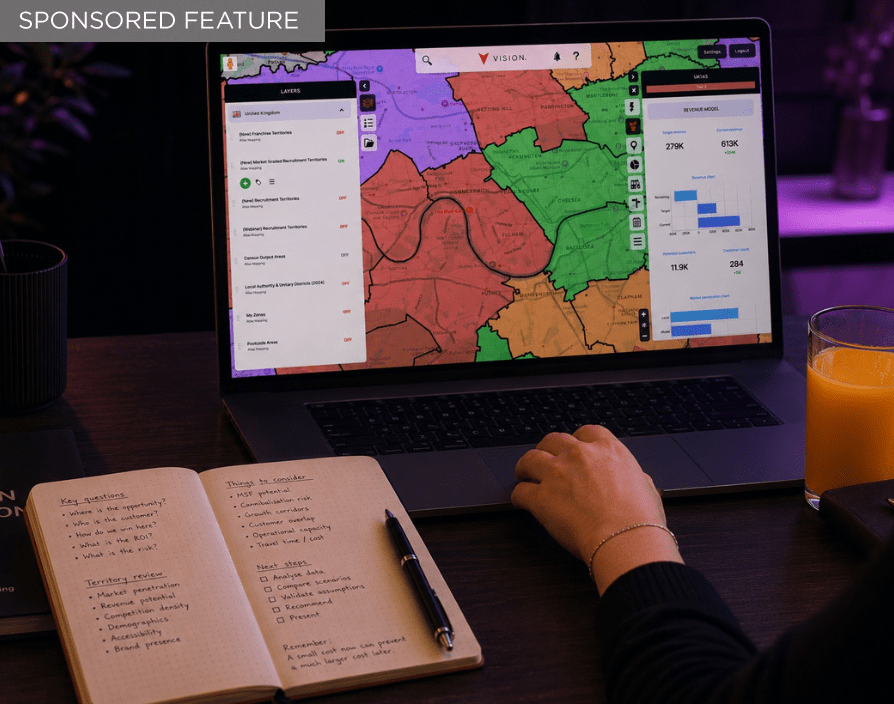
In these hard financial times, businesses aren’t just talking about growth anymore. They’re talking about certainty. Franchisees want confidence before investing. Franchisors want confidence before awarding territories. Consultants and advisers want confidence they’re giving the right advice.
The common thread? Information accuracy and availability.
Information is changing what drives successful franchise networks. Revenue growth isn’t just coming from opening more locations or just spending more on marketing. Increasingly, it’s coming from making better decisions before money is committed.
And those decisions often come down to asking the right questions at the right time.
1. Are you measuring revenue or market penetration?
Two neighbouring territories might generate very different revenues, but that doesn’t necessarily mean one is outperforming the other.
Imagine Territory A generates £800k a year while Territory B generates £600k. On paper, Territory A looks like the clear winner. But what if Territory A has a potential market worth £10m, while Territory B only has £3m? Suddenly, the conversation changes.
One territory is generating more revenue, but the other is capturing a far greater share of the opportunity available to it. Revenue tells you what has happened. Market penetration tells you how much opportunity is left. Understanding the difference can completely change where you focus your investment.
2. Is your next pound actually going to generate a return?
Every franchisor wants growth, but growth always comes with investment. The question isn’t whether to invest, it’s where.
Should the budget go towards recruiting another franchisee? Supporting an existing one? Increasing local marketing? Expanding into a new territory?
The best commercial decisions aren’t based on where money can be spent. They’re based on where it’s most likely to generate a return. It’s also worth considering the difference between actual cost and opportunity cost.
A mapping project, for example, may cost a few thousand pounds. But what does it cost to award a badly placed or sized territory? Or to overlook an area with significantly greater commercial potential? Those decisions don’t just affect the initial sale; they can halve years of MSF income, franchisee performance and future network growth.
A small, visible cost now can prevent a much larger, hidden cost later.
3. Are all of your territories trying to win the same customer?
Not every territory is built the same, so why would every territory follow the same strategy?
An affluent town may respond to a very different message than a university city. Population, demographics, businesses, transport links and local infrastructure all shape customer behaviour.
That might mean optimising which classes run on each of the week, or offering “out of hours” and evening sessions for those working 9-5. It could mean promoting premium packages in more affluent locations, introducing flexible payment options where affordability is a greater consideration, or tailoring marketing campaigns to the local community.
The most successful franchisees are the ones using local insight to deliver the right offer, to the right customer, at the right time.
4. Are you treating symptoms instead of causes?
You can’t market your way out of a poorly designed territory.
When performance starts to plateau, the instinct is often to increase marketing spend, launch another campaign or introduce a new offer. Sometimes that’s exactly the right decision, but sometimes it isn’t.
What if the territory has already reached market saturation? What if the local demographic has changed? What if the service offering no longer reflects the needs of the community? Or what if the territory itself was never designed around the realistic available commercial opportunity in the first place?
The challenge isn’t just identifying that growth has slowed. It’s understanding why. Only once you understand what’s limiting growth can you decide whether the answer is more marketing, a different product or service mix, a territory review, or simply a different local strategy.
It might seem unusual to take business advice from a pop star, but Taylor Swift has built one of the world’s most valuable personal brands. As she put it, “Band-Aids don’t fix bullet holes.” The same applies in franchising. If the underlying issue is the territory itself, no amount of extra marketing will fix it.
5. If you were designing your network today, would it look the same?
It’s an uncomfortable thought because every franchise network carries historical decisions.
Territories are drawn using the whatever information available at the time. But markets don’t stand still.
New housing developments appear. Roads change. High streets evolve. Populations shift. Competitors enter and leave the market. Customer behaviour changes.
The question isn’t, “Did we design good territories?”
It’s, “Knowing what we know today, would we design them this way again?”
That’s where some of the biggest commercial opportunities are found. Not by starting over, but by challenging the assumptions that have quietly become accepted as fact.
When was the last time you challenged your assumptions about your network?
The franchisors that consistently grow their networks aren’t necessarily the ones opening the most locations. They’re the ones creating the greatest certainty before making the next decision by continually asking whether the information they’re using still reflects reality.
Revenue is a lagging indicator. It tells you where you’ve been, not where you should go next
The best business owners don’t leave it to chance. They make the juice worth the squeeze.
This article comes courtesy of Atlas Mapping, an award winning provider of UK franchise territory mapping.