Britain is one of the most permissive franchise markets in the world. Whilst the United States, Canada, France and Australia all bind franchisors to statutory pre-sale disclosure, with tightly prescribed rules on how territories must be defined and presented, the UK operates on trust, contract law and the voluntary Code of Ethics upheld by the BFA. That freedom is often celebrated. It should be scrutinised.
Because when nobody forces you to formalise how you carve up the country, most franchisors don’t. Roughly four in ten UK franchise recruitment pipelines still run on a free tool, a shared postcode spreadsheet, or nothing at all. The brands using nothing rarely admit it, until a franchisee starts complaining that the “premium” area they were sold is smaller, sparser, or nothing like what was described in the discovery call.
The freedom trap
The absence of statutory pressure is not a loophole. It’s a responsibility. In a market without mandatory disclosure, the quality of your territory methodology becomes a competitive signal, one of the strongest a prospective franchisee will use to judge whether your network is serious about its own growth.
Yet most networks treat territory design as an operational afterthought. It sits with whoever answered the phone first. It’s justified with “we’ve always done it this way.” It’s negotiated at the eleventh hour, with a candidate who has already put down a deposit. And it becomes the quiet reason franchisees disengage in year two.
Four mistakes you can spot from the outside
The same patterns show up across dozens of emerging UK networks.
The first is postcode-by-instinct. A founder points at a map, draws a rough ring, and calls it a territory. The population inside that ring is never checked against the brand’s minimum viability threshold. Sometimes it works. Often it doesn’t, and the franchisee who took the underweight territory becomes the network’s loudest sceptic.
The second is the surprise-size territory. Two adjacent candidates sign in the same quarter. Neither is told exactly where their neighbour’s boundary sits. Six months in, one of them discovers, via a postcard mailer, that their exclusive area is forty per cent smaller than they assumed. The franchisor now has a legal argument on their hands, and a reputational one they cannot win.
The third is the undefendable promise. Exclusivity is offered verbally, then contradicted in the signed agreement, then contradicted again by online lead routing. Verbal territory promises are the fastest way to erode franchisee trust, and they make BFA accreditation almost impossible later without unpicking historic contracts.
The fourth is the day-one grid. Keen to look strategic, some founders map the entire country before they have sold their fifth franchise. Every postcode is pre-assigned, every region locked. It feels rigorous. In reality, everything you think you know about your success criteria will change across the first thirty units. Customer profiles shift, drive-time norms move, the cost of servicing rural versus urban patches surprises you. Freezing a national grid on day one guarantees three years spent unpicking territories you signed too early. Map a few steps ahead, learn from each cohort, and let the model evolve alongside the network.
What the best UK networks do differently
The franchisors climbing the EF100 fastest share 3 habits.
They document their territory methodology before they need it, not once they are preparing for BFA accreditation or the day before an exhibition. At any moment, they can tell a candidate exactly which criteria define a viable territory, how those criteria were chosen, and what evidence sits behind each one.
They put the territory conversation earlier in the sales process, not later. Instead of hiding the map until contract stage, they walk candidates through the reasoning during discovery. Counter-intuitively, this speeds recruitment up: candidates who trust the methodology stop shopping around competitors’ proposals.
And they review the model annually. Populations shift, high-street footfall reshapes itself, motorway upgrades redraw drive-time catchments. What was viable in 2023 may be marginal in 2027. The best networks treat territory design as a living asset, not a fossilised one.
The invitation, not the answer
None of this requires expensive GIS software or a specialist analyst. It requires a decision: to treat territory design as strategy, not paperwork. The absence of statutory disclosure in the UK is a gift, but only if you use it. Left alone, it becomes the quiet reason emerging networks stall between twenty and fifty units, the classic UK ceiling, and one most founders never quite understand.
Before your next recruitment cycle, ask yourself whether a stranger could describe your territory methodology in one paragraph. If they can, you have built something defensible. If they cannot, you have your growth project for the next quarter.
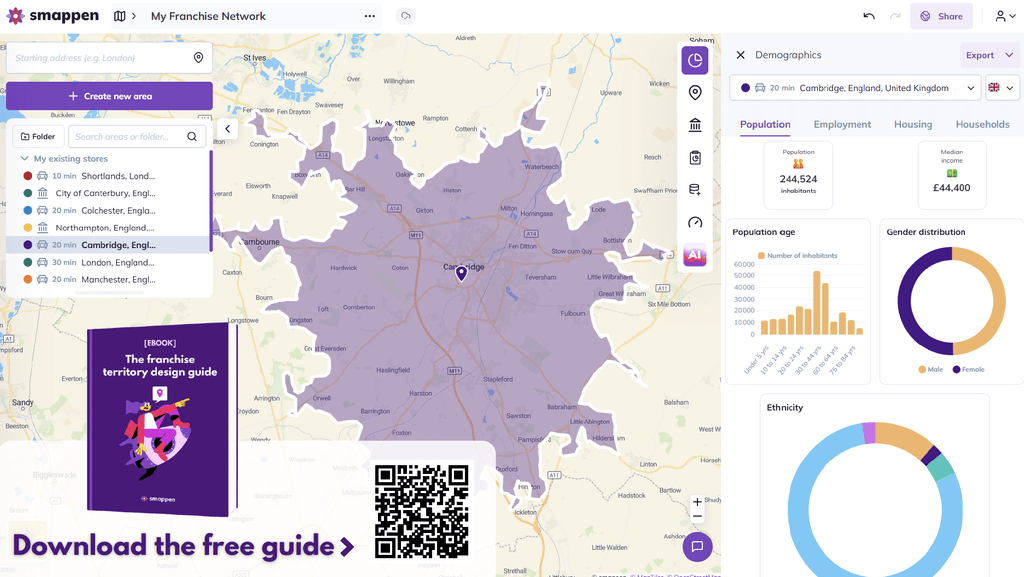
Further reading: Smappen has published a free guide on UK franchise territory design, co-written with UK franchise consultants. It covers catchment analysis, postcode strategy, and how to size territories that stay viable as your network scales. Scan the QR code on the image above to download.
This article comes courtesy of Smappen, the territory mapping tool built for growing franchise networks.