The way people find information has changed more in the last two years than in the previous two decades.
For marketers, the only constant is change and the pace of change has accelerated sharply. Every day brings a new platform update, a new feature, a new “best practice” to keep on top of. AI has reshaped search itself, meaning tactics that used to be reliable, like meta keywords, link volume and templated location pages now count for very little.
For franchisors, this matters more than most realise. When a prospective franchisee researches an opportunity, they are increasingly not scrolling through the top recommended pages, they are asking an AI assistant to summarise the market and tell them who is worth talking to.
If your brand is not part of that answer, you do not just rank lower.
You are invisible.
What exactly are large language models (LLMs)?
We have all got used to turning to the internet for everything. Got a question? Google it. We are no longer uninformed consumers and AI has made it even easier to access expert-level knowledge on almost any topic, instantly.
A large language model is an AI system trained on a vast amount of text including books, articles, web pages and code. Through that training, it learns how language and ideas fit together. When you ask it a question, it draws on the patterns it has learned to generate the most plausible, useful answer. Not by looking up a single page, but by synthesising from many sources at once.
That last part is the bit franchisors need to understand.
A traditional search engine points people to your website. An LLM often answers on your behalf, pulling together what it knows about your brand, your competitors, and your sector, then presenting a single answer. If it does not know enough about you, or trust the information you have shared, it will recommend someone else.
If you ask an LLM a question…
Ask ChatGPT, Gemini or Perplexity “what is the best franchise opportunity in [sector]?” and it will not return a list of paid ads. It will generate an answer based on what it has read about each brand your website, press coverage, review platforms, industry directories, franchisee testimonials, even forum discussions. It is assembling a reputation from fragments, in real time.
If you have not already done this, I would pause reading this article and try it now.
This is the shift franchisors cannot afford to ignore: visibility is no longer about ranking for a keyword. It is about whether the sum total of what exists about your brand online is clear, credible and consistent enough for an AI to confidently recommend you.
Building a clear digital footprint
Brand visibility is now delivered in a different way. Answer engines extract and assemble responses from sources they trust, which means your content has to be easy to extract, consistent, and backed by real evidence, not just marketing claims.
LLMs do not scroll like a human reader; they pull out discrete, quotable facts. Take a typical claim: “We offer industry-leading training and support for every franchisee.” An LLM cannot do anything with “industry-leading” it is a claim, not a fact.
Compare that to: “Every franchisee completes a four-week onboarding programme before opening, backed by ongoing monthly business reviews for the first two years.” That is specific enough to be checked (by looking at reviews, documents, case-studies) and specific enough for an AI to repeat as a genuine differentiator.
The most effective way to deliver this is with problem-led content. Do not start with your franchise, start with the question your ideal franchisee is actually asking: “How much does it cost to open a [sector] franchise?” “What support do franchisors provide in year one?” Answer it directly and specifically near the top of the page, then expand with evidence. That is exactly the shape an LLM looks for when assembling an answer, and it is far more likely to get pulled into one than content written primarily to describe your brand.
On average, 70% of the buying decision is made before a prospect even speaks to the company and increasingly, that decision is shaped by an AI-generated summary the prospect never sees the sources for. If your brand is not feeding that summary, someone else’s is.
A new way to optimise your content
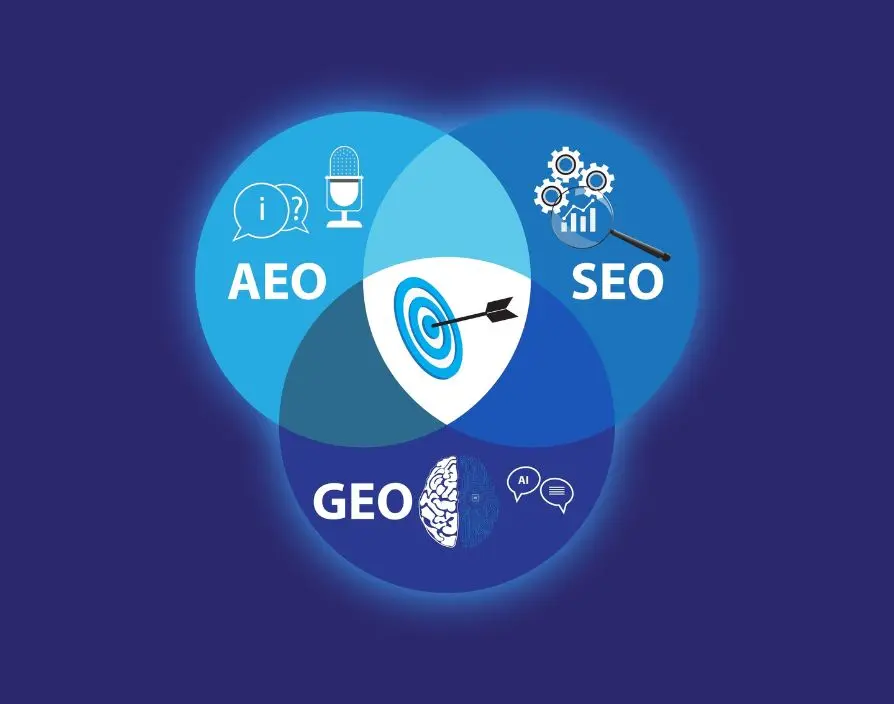
Traditional SEO rewarded keyword density and backlinks. Optimising for AI answer engines AEO or GEO, rewards clarity, structure and trustworthiness instead. A few practical shifts:
- Write extractable answers. Short, direct paragraphs that answer one question fully, rather than long narrative build-ups.
- Use clear structure. Headers, bullet points and FAQ sections make it far easier for an AI to identify and lift a specific answer.
- Back up claims with data. Named statistics, sources and dates give an AI something concrete to cite, vague superlatives do not.
- Keep information consistent everywhere. If your website, franchise directory listing and press coverage disagree on basic facts (number of units, launch year, investment level), that inconsistency erodes the trust an AI needs to recommend you confidently.
The necessity of third-party authority
Here is the part that surprises a lot of marketers: you cannot fully control this through your own website.
LLMs weigh third-party sources, industry press, review platforms, franchise directories, independent commentary, often more heavily than brand-owned content, because they are seen as less biased.
This means PR, credible media coverage and genuine editorial mentions are not just brand-building exercises anymore. They are becoming part of your AI visibility infrastructure. A franchise that is been written about by trusted, independent industry sources builds a body of external evidence that an LLM can draw on and trust. A franchise that only exists on its own website has a much thinner footprint to be recommended from.
Reviews still remain an important part of brand visibility
None of this replaces the fundamentals.
Reviews from franchisees, customers and industry bodies remain one of the clearest trust building content to humans and AI systems. LLMs draw on review platforms when assembling answers about reputation, satisfaction and support quality, so a thin or outdated review profile is still a real gap.
Will AI be recommending your franchise?
The brands that will be recommended by AI over the next few years will not necessarily be the ones with the biggest marketing budgets. They will be the ones with the clearest, most consistent, most independently verified digital footprint. That is a different discipline to traditional marketing and it is one every franchisor needs to start building now.
The good news is that none of this requires starting from scratch. It means auditing what is already out there about your brand, tightening the gaps, and being deliberate about the facts, evidence and third-party voices you put into the world. Franchisors who do that now will not just be visible in web searches, they will be the answer.
Key takeaways
- Large language models (LLMs) like ChatGPT, Gemini and Perplexity answer questions directly rather than pointing to websites – if your franchise is not in their training data, you are invisible to a growing segment of prospects.
- LLMs favour extractable, specific, structured content over vague brand language – a claim like ‘four-week onboarding programme with ongoing field support’ is far more citable than ‘comprehensive support’.
- Optimising for AI answer engines (AEO/GEO) rewards content clarity, named statistics, consistent information across all platforms, and direct answers to the questions your prospects are actually asking.
- Third-party authority matters more than ever – PR, credible media coverage and editorial mentions are now a direct input into whether AI recommends your franchise, not just a brand-building exercise.
- Reviews from franchisees, customers and industry bodies remain a key trust signal for AI systems – the brands AI recommends will be those with the clearest, most consistent and most credible digital presence.